Mazda CX-5 vs VW ID.4
Almost the same size on the outside. They use the space inside very differently.
Pick the CX-5 if you want…
- More rear headroom and legroom
- More ground clearance (7.6 in)
- A lighter car (about 600 lb less)
Pick the ID.4 if you want…
- More cargo space with the seats folded
- A much tighter turning circle
- More front headroom and a longer wheelbase
At a glance
The 2018 Cadillac XT4 is included for size reference. It is the longest and widest of the three, but it has the least cargo space.
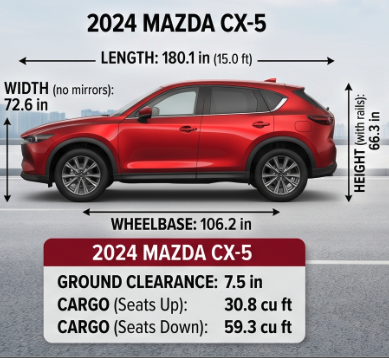
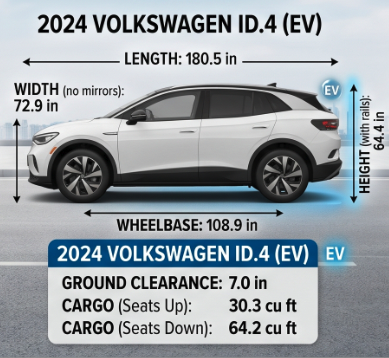
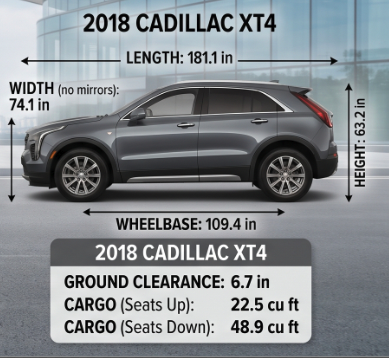
Ground clearance varies by trim. The charts below use 7.6 in for the CX-5 2.5 S and 6.1 in for the rear-wheel-drive ID.4s on the shortlist (6.9 in with AWD).
Outside
Bars are to scale. Length and width are within half an inch of each other.
Inside
Both seat five. The CX-5 gives rear passengers more room. The ID.4 gives the driver more headroom.
Cargo & capability
Almost identical with the seats up. Fold them down and the ID.4 holds about 5 cu ft more.
FAQ
Which one is bigger?
From the outside, neither. The ID.4 is 0.4 in longer and 0.3 in wider, and the CX-5 is about 1.7 in taller. Parked next to each other you would not notice. The real difference is the wheelbase: the ID.4's wheels sit 2.7 in farther apart, and with no engine up front, more of its length goes to the cabin and cargo area.
Will either one fit in my garage?
Both are about 15 ft long and about 6 ft wide without mirrors (the CX-5 is 83.3 in, about 7 ft, mirror to mirror). A standard 20 ft deep garage leaves about 5 ft of walking room with either car. If one fits, the other fits too.
Which has more room for passengers?
It depends on the seat. Up front, the ID.4 has 0.9 in more headroom (40.6 vs 39.7). In the back, the CX-5 wins: 1.1 in more headroom (39.0 vs 37.9) and 2 in more legroom (39.6 vs 37.6). If adults ride in the back seat a lot, the CX-5 is roomier.
Which holds more cargo?
With the rear seats up, they are basically tied: 30.8 cu ft in the CX-5 and 30.3 in the ID.4. With the seats folded, the ID.4 pulls ahead at 64.2 cu ft vs 59.3, about 8 percent more. That is roughly two extra carry-on suitcases.
Why does the ID.4 turn so much tighter?
The rear-wheel-drive ID.4 has no engine or drive shafts between the front wheels, so they can turn much farther. It turns around in 31.5 ft, against 36 ft for the CX-5. That is a 4.5 ft smaller circle, which helps in parking garages and U-turns. The all-wheel-drive ID.4 loses most of that advantage (about 36.4 ft).
Which is better on dirt roads or at the trailhead?
The CX-5. It has 7.6 in of ground clearance, against about 6.1 in for a rear-wheel-drive ID.4 (6.9 in with AWD). Every CX-5 in the US comes with all-wheel drive. All the ID.4s on the shortlist are rear-wheel drive.
How far does the ID.4 go on a charge?
The shortlist's ID.4s are Standard and S trims with the smaller 62 kWh battery, rated around 206 miles by the EPA. That covers daily Vegas driving easily with home charging. Summer heat and highway speeds cut into that number, so plan on less for long drives to LA or Utah.
Can either one tow?
Only light loads. The CX-5 is rated for 2,000 lb and the rear-wheel-drive ID.4 for 2,200 lb (2,700 lb with AWD). Towing will cut the ID.4's range sharply.
Why is the ID.4 so much heavier?
The battery. The ID.4 weighs about 4,300 lb against about 3,700 lb for the CX-5. The battery sits flat under the floor, so the weight is low and the car feels planted, but it also wears tires faster, which the 5-year cost table on the shortlist already accounts for.
ID.4 fun facts
Play and pause pedals
Look down: the accelerator pedal has a ▶ play symbol and the brake has a ⏸ pause symbol.
The dashboard light bar
A strip of light at the base of the windshield, called ID.Light, flashes for turn directions, incoming calls, and charging status.
Drum brakes in back
Rear-wheel-drive ID.4s use old-school drum brakes on the rear wheels. Regenerative braking does most of the stopping, and drums do not rust up from sitting unused the way discs do.
Rear engine, like the Beetle
The motor sits at the back and drives the rear wheels, the same layout as the original VW Beetle.
Built in Tennessee
ID.4s sold in the US have been built in Chattanooga since 2022. It was VW's first EV built in America.
World Car of the Year
The ID.4 won the 2021 World Car of the Year award in its first year on sale.
Shares its bones
It rides on VW's MEB platform, the same foundation under the Audi Q4 e-tron and the Ford Explorer EV sold in Europe.
No frunk
Pop the hood and there is no front trunk. The space holds the climate system and electronics instead.